Sunday, October 01, 2006
Introduction
Have you ever been on a safari?
You will be traveling with Sally on a safari through the cell to discover the parts and their functions. These parts are called organelles. Your adventure will begin in either the plant or animal cell. Imagine being small enough to enter each part to see how it performs it’s job. You will then relate this information to the jobs of a factory or city. At the end you will be creating a 3-D model of either the plant or animal cell. The report and model will be finished at home and presented in class. Happy safari hunting!
You will be traveling with Sally on a safari through the cell to discover the parts and their functions. These parts are called organelles. Your adventure will begin in either the plant or animal cell. Imagine being small enough to enter each part to see how it performs it’s job. You will then relate this information to the jobs of a factory or city. At the end you will be creating a 3-D model of either the plant or animal cell. The report and model will be finished at home and presented in class. Happy safari hunting!

Your Task
At the end of your safari trip through the cell you will be producing two products. The first will be the comparison of the function of the cell parts to either the parts of a city or a factory in a written report. The second product will be creating a 3-D cell depicting all the parts of either an animal or plant cell. Your model will include labels of each cell part and a key. Use symbols on the key to correlate to the part. You need to decide which cell you want to do before starting your safari. Remember to choose a plant or animal cell.
Process
To complete your cell safari you are to:
1. Go to http://vilenski.org/science/safari
2. Decide if you will choose a plant or animal cell for your written report and 3-D model. Click on either the plant or animal cell.
3. Take notes on the cell parts as you travel through the cell safari, keeping in mind how this relates to your writing assignment and cell project.
4. Click on each cell part to see what it looks like and it’s function. Remember to jot down information as you go along to be used for your report.
5. Be sure to view all cell parts before leaving this site.
6. Go to http://www.cellsalive.com to view a real cell and what the part looks like. Click on Cell Biology and then choose animal or plant cell, whichever you have chosen to do.
7. Choose a cell part and view each cell part and compare it to the information you already have. Click Back to view next cell part. Write any notes you may need for your report or model.
8. Your report will be written at home and may be typed if you choose. Be sure to include 10-12 cell parts in your written report.
9. Your 3-D model will be constructed at home and I will give you reminder guidelines for this project. Include at least 10-12 cell parts on your model.
1. Go to http://vilenski.org/science/safari
2. Decide if you will choose a plant or animal cell for your written report and 3-D model. Click on either the plant or animal cell.
3. Take notes on the cell parts as you travel through the cell safari, keeping in mind how this relates to your writing assignment and cell project.
4. Click on each cell part to see what it looks like and it’s function. Remember to jot down information as you go along to be used for your report.
5. Be sure to view all cell parts before leaving this site.
6. Go to http://www.cellsalive.com to view a real cell and what the part looks like. Click on Cell Biology and then choose animal or plant cell, whichever you have chosen to do.
7. Choose a cell part and view each cell part and compare it to the information you already have. Click Back to view next cell part. Write any notes you may need for your report or model.
8. Your report will be written at home and may be typed if you choose. Be sure to include 10-12 cell parts in your written report.
9. Your 3-D model will be constructed at home and I will give you reminder guidelines for this project. Include at least 10-12 cell parts on your model.
Evaluation
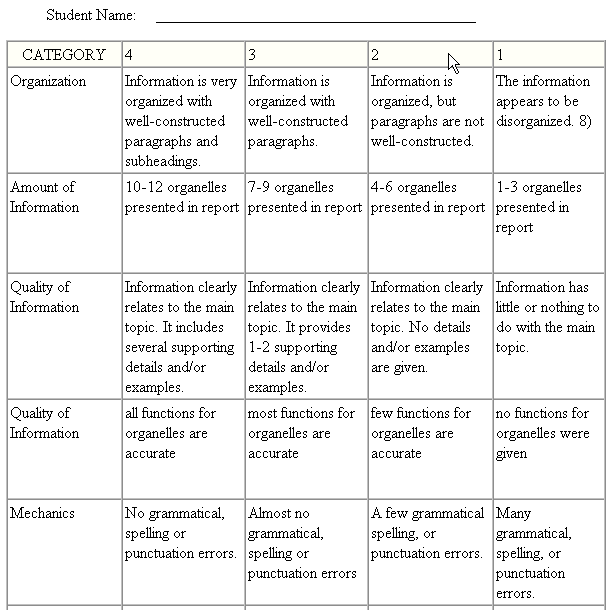
Your performance will be evaluated on your written report and your 3-D cell project, how well you followed directions and your presentation. You will be given an individual grade on the report and the cell project separately. The cell model will be presented in class and you will be asked questions about the functions of each cell part. Study the rubrics below to check if you are satisfied with your completed project and report.
Below are the scoring rubrics. Click on the images to make them bigger. You might want to print them out for future reference.
Below is the written report rubric.

This is the 3-D cell model rubric.

Below are the scoring rubrics. Click on the images to make them bigger. You might want to print them out for future reference.
Below is the written report rubric.
This is the 3-D cell model rubric.

Conclusion
When you have completed your notes in both websites, check to make sure you have all the information you need to compare a cell and it’s parts to a city or factory. Then check to make sure you know the location of each part to include in your model. If you have extra time go back to Cell Safari and click on either of the other living things, fungus, bacteria or protists and make a comparison of the way they are alike or different from your plant or animal cell. If you still have time go to the original site and click on eukaryotic to find the definition and it’s characteristics.
